Is mining's biggest challenge data quality or data connection?
The short answer: mining’s biggest challenge is both data quality and data connection. Data has to be trustworthy, and it has to flow across every stage of the mining lifecycle. Good data stuck in silos and connected data no one trusts both lead to slower, riskier decisions.
Ask a room of mining professionals what holds back better decisions and the answer usually comes quickly: data quality. Assays that need re-checking. Duplicates that don’t reconcile. Standards that fail and go unnoticed for weeks.
It’s a fair answer, but it’s only half of it. Mining companies are generating more data than ever, from drilling, sampling, laboratories, geological models, grade control and production reporting. Much of that data is good. The problem is that it sits in separate systems, spreadsheets and teams that don’t talk to each other. So which is the bigger challenge for mining data management: the quality of the data, or the connections between it?
Why data quality matters in mining
Data quality has always been the foundation of good geology. Every resource estimate, mine plan and investment decision depends on the assays and observations behind it. If those are wrong, everything built on them is wrong too.
That’s why QAQC matters so much. Contamination, assay drift, failed standards and duplicate discrepancies can look minor in isolation. Left undetected, they quietly erode confidence in results, and they often surface only when they’re expensive to fix: during a resource audit, a reporting deadline or a due-diligence review.
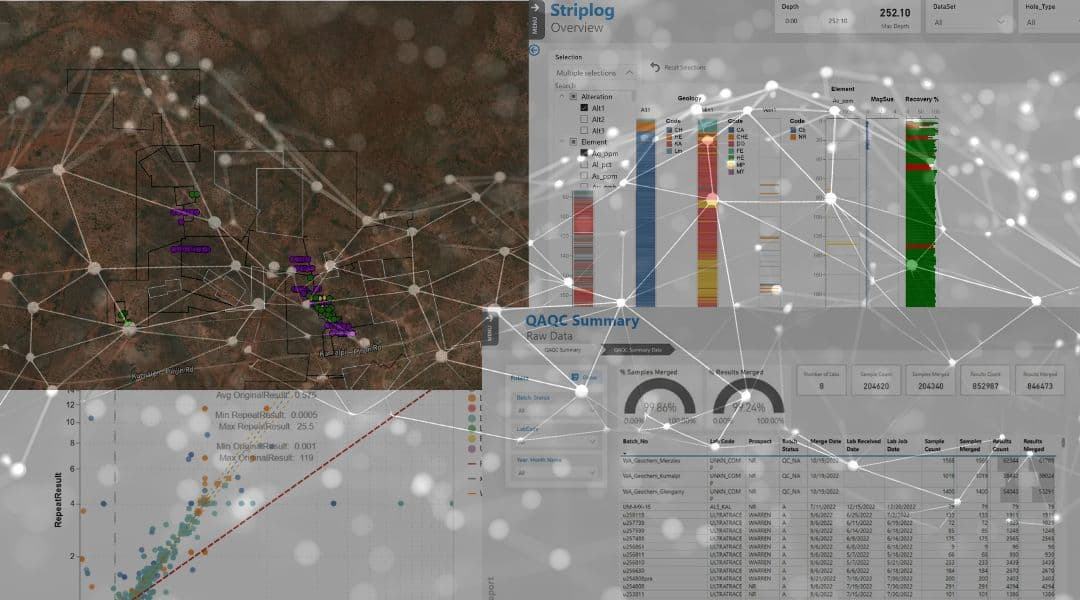
Automating these checks makes a real difference. Tools such as maxgeo’s Advanced Assay Management flag failed standards, blanks and duplicates as results arrive, so issues are caught before they reach a resource estimate.
Reporting codes and investors expect companies to show that their data can be trusted. On that basis, it’s easy to argue that quality is the challenge that matters most.
Why data silos in mining may be the bigger problem
Here’s the catch: data can pass every quality check and still let you down.
A validated assay is only useful if the people who need it can find it, trust that it’s the latest version, and use it in the next step without retyping it. In many operations, that’s where things break. Exploration data lives in one database, laboratory results arrive in another format, the resource team works from exported files, and production reporting runs on its own spreadsheets.
Every handover between those systems is a chance for something to go wrong. Data gets copied, reformatted, re-entered and re-checked. Different teams end up with different versions of the truth. Decisions slow down, not because the data is poor, but because no one can see all of it in one place.
In other words, a lot of what looks like a data quality problem is really a connection problem. Errors creep in at the gaps between systems, not only at the point of collection.
Why data quality and data connection can’t be separated
The honest answer to the question is that quality and connection depend on each other.
- Without quality, connecting systems just spreads bad data faster.
- Without connection, good data gets lost, duplicated or degraded as it moves between teams.
Trust in data isn’t created once, at the point of capture. It has to be maintained at every stage of the mining lifecycle, from the first drill hole through resource definition, planning, production and reconciliation. That only works when quality checks and the flow of data are designed together.
This matters even more as the industry looks to automation and AI. AI is only as good as the data behind it, and it needs data that is both trustworthy and accessible across the operation. Clean data locked in silos won’t get you there, and neither will connected data you can’t trust.
What connected mining operations look like
The next step for many mining companies isn’t another piece of standalone software. It’s connection across the entire lifecycle. In practice, that means:
- One source of truth. Validated data lives in one place, so every team works from the same version.
- Quality built into the flow. QAQC happens automatically as data moves, not as a separate clean-up exercise at the end.
- Integration with what you already use. Geological, laboratory, mine planning and reporting tools share data instead of exporting and re-importing it.
- Visibility across every stage. Managers see trends, risks and progress across the operation, not just one part of it.
Where to start with connecting your mining data
- Map where your data is created, stored and handed over today.
- Find the handovers that rely on manual exports, spreadsheets or re-keying. That’s where errors and delays usually start.
- Check whether your QAQC results are visible to the people making decisions further down the line.
- Prioritise connecting the stages where a delay or error costs the most.
How maxgeo connects trusted data across the lifecycle
maxgeo brings validated data and the tools that use it into one connected environment. datashed provides a single, validated source of truth for geological data management. Advanced Assay Management builds QAQC into the flow of laboratory results dsCONNECT shares exploration and geological data it with the geology, mine planning and reporting tools your teams already use, including Leapfrog.
Frequently asked questions
Is mining’s biggest challenge data quality or data connection?
It’s both. Quality makes data trustworthy, and connection makes it usable across exploration, resource definition, planning, production and reconciliation. Treating them separately leaves either good data locked in silos or connected data no one can trust.
What are data silos in mining?
Data silos are separate systems, databases and spreadsheets that hold related information but don’t share it, such as drilling, laboratory, modelling and production data. They lead to duplication, manual re-entry and different teams working from different versions of the data.
What is a single source of truth for mining data?
It’s one central, validated place where mining data is stored and accessed, so every team uses the same, latest version. It reduces errors from copying and re-keying and makes reporting faster and more reliable.
What is geological data management?
Geological data management is the process of capturing, validating, storing and sharing exploration and mining data, such as drillhole, sampling and assay results, so it can be trusted and used for resource estimates, mine planning and reporting.
How does QAQC improve confidence in assay data?
QAQC uses standards, blanks and duplicates to detect contamination, assay drift and laboratory errors early. Automated QAQC reporting makes issues visible before they affect resource estimates or decisions.
Is mining data ready for AI?
Only if it is both high quality and accessible. AI and automation depend on clean, validated data that can be drawn from across the operation, not just from one system.
So, which matters more?
Is mining’s biggest challenge data quality or data connection? We’d argue it’s both, and that treating them as separate problems is what keeps many operations stuck. The companies that get ahead will be the ones that connect trusted data across every stage of the mining lifecycle, from the first drill hole to reconciliation.
That’s the conversation maxgeo has been having with geologists, database administrators and mine managers for more than 25 years, and it’s where we’re focusing next.
We’d like to hear your view: in your operation, does data fall down more often on quality, or in the handover between systems?
Let's talk about it.
Whether it's quality, connection or both, our team can help you find the gaps and show you how maxgeo connects trusted data from the first drill hole to reconciliation.